 Pod Save America Hosts Call on Democrats to Cut All Israel Military Aid, No Longer Accept AIPAC Funding
 Jews, Israelis Targeted in Austria Amid Surge in Antisemitic Incidents; Local Jewish Community Calls for Action
 ‘All of Our Strength’: Over 1,000 Pro-Israel Activists Gather in DC for Solidarity Conference
 ‘Devastated’: Wesley LePatner, Killed in Manhattan Mass Shooting, Was a Jewish Communal, Philanthropic Leader
 Sen. Angus King Vows to No Longer Vote for Israel Military Aid Until Gaza Conditions Improve
 Europe Won’t Pressure Israel to ‘Commit Suicide’ Amid Gaza Backlash, Palestinian State Push, Says Israeli FM
 Israel’s National Soccer Coach Attacked in Athens Before Soccer Fans Chant ‘F–K Israel, Free Palestine’ at Match
 New York Judge Sentences Neo-Nazi to 5 Years for Livestreaming Bomb Threats Against Jewish Hospitals
 US Pressures Lebanon to Issue Cabinet Decision to Disarm Hezbollah Before Talks Continue
 UK Plans to Recognize Palestinian State in September Unless Israel Meets Conditions, Starmer Says


New York Times ‘Ceasefire’ Coverage Laments That Israel Will Exist
Error: Contact form not found.
 by Ira Stoll

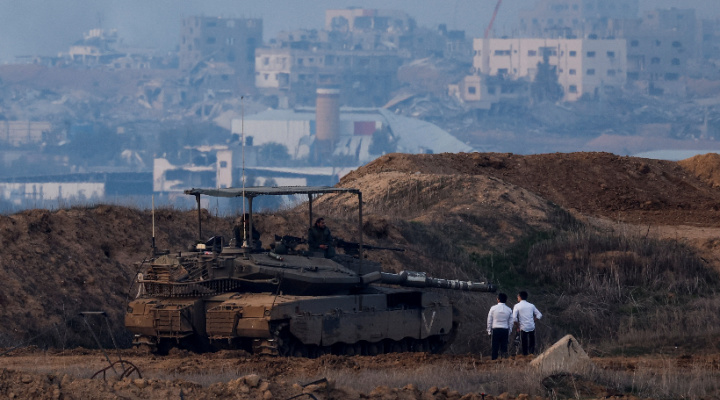
Orthodox Jewish men stand near a tank, ahead of a ceasefire between Israel and Hamas, as seen from the Israeli side of the border with Gaza, Jan. 16, 2025. Photo: REUTERS/Amir Cohen
The New York Times news coverage of Israel and the Middle East is becoming increasingly unmoored from reality.
A recent Times article about a ceasefire in Gaza carries five bylines — Aaron Boxerman, Rawan Sheikh Ahmad, Johnatan Reiss, Ephrat Livni, and Adam Rasgon. A sixth reporter, Nick Cumming-Bruce, is credited at the end of the piece for having “contributed reporting from Geneva.” With so many people involved, accuracy and accountability is more difficult.
The Times article reports, “Aid workers also hope that the cease-fire would allow for far more medical evacuations. The WHO reported that Israel had approved the evacuation of 5,405 patients since the start of the war. But the pace of evacuations slowed to a trickle after Israel closed the Rafah crossing in May.”
Actually it was not “Israel” that “closed the Rafah crossing,” which is a passage between Gaza and Egypt. The Rafah crossing was closed by Egypt after the Israelis took over the other side. That threatened to end the smuggling that reportedly brought in huge bribe revenues to powerful people in Egypt.
Another Times article about the ceasefire — this one under Rasgon’s solo byline, though with reporting contributed by Boxerman and Jerusalem bureau chief Patrick Kingsley — is no more accurate. “When Hamas launched its Oct. 7, 2023, attack against Israel, it had hoped to ignite a regional war that would draw in its allies and lead to Israel’s destruction. Instead, it has been left to fight Israel almost entirely alone,” the Times writes. This conveniently skips over how Israel was attacked by Hezbollah, from Iran, and by some students and faculty on US and European university campuses. Prime Minister Netanyahu has described it as a “seven-front” war — not only Gaza, but also Lebanon, Iraq, Syria, Yemen, Iran, and Judea and Samaria (also known as the West Bank).
The Times does mention attacks on Israel from Yemen, but it describes them airily as “occasional rocket and drone attacks, most of which Israel has intercepted.” If the “occasional rocket and drone attacks” had targeted, say, the New York Times bureau in Washington, or Columbia Journalism School, one doubts that the Times would be so casually dismissive of them.
The Times article concludes:
For many civilians, a future with both Israel and Hamas in the picture is bleak.
“We’re talking about a people stuck between a state ready to act with total brutality and a group ready to provoke that state to act with brutality,” said Akram Atallah, a Palestinian columnist from Gaza.
That passage draws a strange equivalence between Israel and Hamas, an internationally designated terrorist group. What would the future look like without Israel in the picture? That would also be pretty bleak for the Jews who live there, who can expect to be treated with the same cruelty that Hamas treated its victims on Oct. 7, 2023.
Who is this Akram Atallah? In the past, according to Palestinian Media Watch, he’s likened Israel to Shakespeare’s caricature of Shylock. The Washington Post has reported that Atallah “was imprisoned with [former Hamas leader Ismail] Haniyeh in the early 1990s in Israel.”
This is the journalist the New York Times turns to for expert commentary?
For many civilian readers hoping for factual, reliable journalism about Israel and its neighbors, the present — with the New York Times distorting reality and indulging fantasies about wiping Israel off the map — is pretty bleak.
No one is asking the Times to be a spokesman for Netanyahu or his Likud Party. At least, that isn’t what I’m hoping for. I’d settle for just simple factual accuracy about issues such as who closed the Rafah crossing or which parties attacked Israel. Or, minimally, for the ability to draw a distinction between Israel and Hamas.
Ira Stoll was managing editor of The Forward and North American editor of The Jerusalem Post. His media critique, a regular Algemeiner feature, can be found here.