 Pod Save America Hosts Call on Democrats to Cut All Israel Military Aid, No Longer Accept AIPAC Funding
 Jews, Israelis Targeted in Austria Amid Surge in Antisemitic Incidents; Local Jewish Community Calls for Action
 ‘All of Our Strength’: Over 1,000 Pro-Israel Activists Gather in DC for Solidarity Conference
 ‘Devastated’: Wesley LePatner, Killed in Manhattan Mass Shooting, Was a Jewish Communal, Philanthropic Leader
 Sen. Angus King Vows to No Longer Vote for Israel Military Aid Until Gaza Conditions Improve
 Europe Won’t Pressure Israel to ‘Commit Suicide’ Amid Gaza Backlash, Palestinian State Push, Says Israeli FM
 Israel’s National Soccer Coach Attacked in Athens Before Soccer Fans Chant ‘F–K Israel, Free Palestine’ at Match
 New York Judge Sentences Neo-Nazi to 5 Years for Livestreaming Bomb Threats Against Jewish Hospitals
 US Pressures Lebanon to Issue Cabinet Decision to Disarm Hezbollah Before Talks Continue
 UK Plans to Recognize Palestinian State in September Unless Israel Meets Conditions, Starmer Says


Syria’s President Visits Saudi Arabia in First Foreign Trip Since Assad’s Fall
Error: Contact form not found.
 by Ailin Vilches Arguello

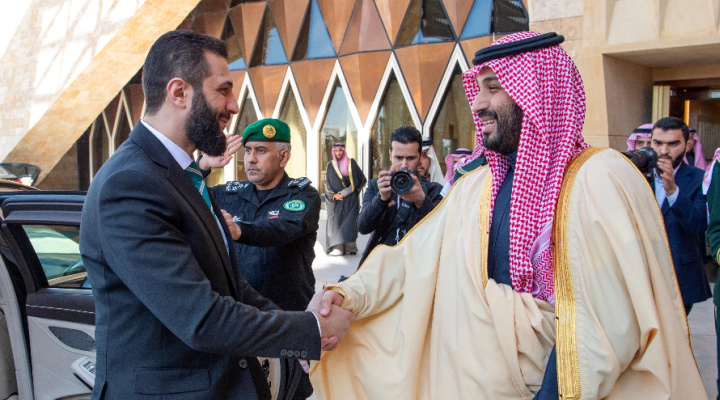
Syria’s newly appointed president for a transitional phase Ahmed al-Sharaa meets Saudi Crown Prince, Mohammed Bin Salam, in Riyadh, Saudi Arabia, Feb. 2, 2025. Photo: Bandar Algaloud Saudi Royal Royal Court/Handout via REUTERS
Syria’s transitional president, Ahmed al-Sharaa, visited Saudi Arabia on Sunday in his first foreign trip as Syrian leader, signaling a shift in regional alliances and a move away from Iran as the country’s main ally in the Middle East.
After meeting with Saudi Crown Prince Mohammed bin Salman, Sharaa said in a statement that they discussed strengthening bilateral ties, regional developments, and cooperation in humanitarian and economic matters, along with “extensive future plans in energy, technology, education, and health.”
Last week, Sharaa became Damascus’s transitional president after leading a rebel campaign that ousted long-time Syrian leader Bashar al-Assad, whose Iran-backed rule had strained ties with the Arab world during the nearly 14-year Syrian war.
According to an announcement by the military command that led the offensive against Assad, Sharaa was given the authority to form a temporary legislative council for the transitional period and to suspend the country’s constitution.
The collapse of al-Assad’s regime was the result of an offensive spearheaded by Sharaa’s Islamist Hayat Tahrir al-Sham (HTS) group, a former al-Qaeda affiliate.
Al Sharaa is in Saudi Arabia, his first ever official visit since the ouster of Assad pic.twitter.com/e5qUUsPv7C
— Ragıp Soylu (@ragipsoylu) February 2, 2025
During the “Conference for Announcing the Victory of the Syrian Revolution,” Sharaa said that the first priority was to fill the government vacuum “in a legitimate and legal way.”
Since Assad’s fall, the new Syrian government has sought to strengthen ties with Arab and Western leaders.
In these efforts, Saudi Arabia has played a key role, hosting Damascus’s new foreign and defense ministers in early January and later organizing a meeting with Syrian, Arab, and Western officials.
Last week, Qatar’s Emir Sheikh Tamim bin Hamad Al-Thani became the first head of state to visit Damascus after the collapse of Assad’s regime.
Syria’s new diplomatic relationships reflect a distancing from its previous allies, Iran and Russia. Iran, for example, has not reopened its embassy in Damascus, which was a central part of its self-described “Axis of Resistance” against US-backed Israel, including Assad’s Syria and a network of terrorist proxies — primarily Hezbollah in Lebanon.
Meanwhile, Russia seeks to preserve access to its air and sea bases in Syria, but Moscow took in Assad when he fled the country in December. Syria’s new government has requested Assad’s extradition.
The Assad regime’s brutal crackdown on opposition protests in 2011 sparked the Syrian civil war, during which Syria was suspended from the Arab League for more than a decade.
The new Syrian government appears focused on reassuring the West and working to get sanctions lifted, which date back to 1979 when the US labeled Syria a state sponsor of terrorism and were significantly increased following Assad’s violent response to the anti-government protests.
However, Damascus still faces significant instability and challenges, including threats from the Islamic State terrorist group and other militants in the country. On Monday, a car bomb exploded in Manbij in northern Syria, killing at least 19 people, mostly women, and leaving over a dozen wounded.