 Pod Save America Hosts Call on Democrats to Cut All Israel Military Aid, No Longer Accept AIPAC Funding
 Jews, Israelis Targeted in Austria Amid Surge in Antisemitic Incidents; Local Jewish Community Calls for Action
 ‘All of Our Strength’: Over 1,000 Pro-Israel Activists Gather in DC for Solidarity Conference
 ‘Devastated’: Wesley LePatner, Killed in Manhattan Mass Shooting, Was a Jewish Communal, Philanthropic Leader
 Sen. Angus King Vows to No Longer Vote for Israel Military Aid Until Gaza Conditions Improve
 Europe Won’t Pressure Israel to ‘Commit Suicide’ Amid Gaza Backlash, Palestinian State Push, Says Israeli FM
 Israel’s National Soccer Coach Attacked in Athens Before Soccer Fans Chant ‘F–K Israel, Free Palestine’ at Match
 New York Judge Sentences Neo-Nazi to 5 Years for Livestreaming Bomb Threats Against Jewish Hospitals
 US Pressures Lebanon to Issue Cabinet Decision to Disarm Hezbollah Before Talks Continue
 UK Plans to Recognize Palestinian State in September Unless Israel Meets Conditions, Starmer Says


Massive Crowds Mourn Hezbollah’s Slain Leader Nasrallah
Error: Contact form not found.
 by Reuters and Algemeiner Staff

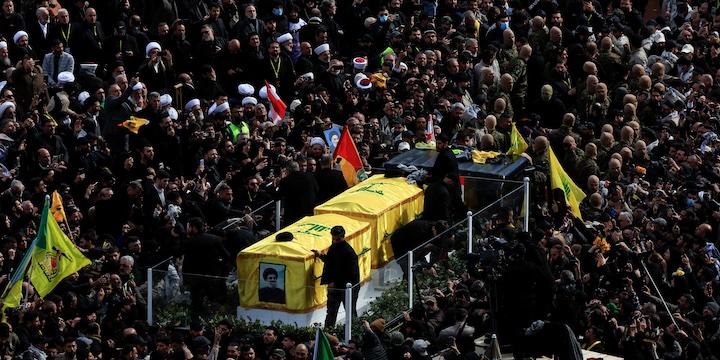
Funeral ceremony for former Hezbollah leaders Hassan Nasrallah and Hashem Safieddine, outskirts of Beirut, February 23, 2025. Photo: REUTERS/Thaier Al-Sudani
Hundreds of thousands of people bid farewell to Hezbollah’s slain leader Hassan Nasrallah at a mass funeral in Beirut on Sunday, nearly five months after he was killed in an Israeli airstrike in a stunning blow to the Iranian-backed group.
Carrying pictures of Nasrallah and Hezbollah flags, supporters from Lebanon and other countries in the region filled the 55,000-seat Camille Chamoun Sports City stadium in the Hezbollah-controlled southern suburbs of Beirut.
After a ceremony, they joined a funerary procession outside the stadium before burying Nasrallah nearby. A Lebanese security source estimated the crowd at about a million people.
The killing of Nasrallah, who led the Shi’ite Muslim group through decades of conflict with Israel and oversaw its transformation into a military force with regional sway, was one of the opening salvos in an Israeli escalation that badly weakened Hezbollah.
But the group’s current leader, Naim Qassem, whose address to mourners was broadcast on screens from an undisclosed location, said Hezbollah remained “strong.”
“We will not submit and we will not accept the continuation of our killing and occupation while we watch,” Qassem said.
Though Israel’s military has largely withdrawn from southern Lebanon, its air force is still striking what it says are Hezbollah positions across Lebanon and troops still hold five hilltop positions along the border.
Israeli troops also detained Lebanese civilians and Hezbollah fighters in south Lebanon, and have the bodies of slain Hezbollah fighters in their custody.
Qassem said Hezbollah would exert pressure to get them returned home. He said Hezbollah considered Israel’s five positions an occupation and was relying on the Lebanese government to secure a full withdrawal through diplomacy.
“We choose to fire when we see fit and are patient when we see fit,” he said.
Israeli warplanes struck in Lebanon’s south and east on Sunday and flew low over Beirut twice during the funeral, prompting shouts of “Death to Israel”.
Israel’s foreign minister, Israel Katz, said on X that the planes “above Hassan Nasrallah’s funeral are conveying a clear message: whoever threatens to destroy Israel and attacks Israel – that will be the end of him. You will specialize in funerals – and we will specialize in victories.”
Israel’s military published a video of what it described as footage of Nasrallah’s killing “in several simultaneous raids.” Black-and-white footage, which appeared to be shot from a military plane, showed buildings hit by around a dozen blasts in quick succession.
‘CLINGING ON’
Among those at the funeral were Iranian Foreign Minister Abbas Araqchi, an Iraqi delegation including Shi’ite politicians and militia commanders, and a delegation from Yemen’s Houthis.
The mass funeral is aimed at showing strength after Hezbollah emerged battered from last year’s war with Israel, which killed most of its leadership and thousands of fighters, and wreaked destruction on south Lebanon.
Its weakened stature has been reflected in Lebanon’s post-war politics, with the group unable to impose its will in the formation of a new government and language legitimizing its arsenal omitted from the new cabinet’s policy statement.
The impact on Hezbollah was compounded by the ousting of its ally Bashar al-Assad in Syria, severing a key supply route.
“We may have lost a great deal as a man, but we have not lost the value of the resistance because the resistance is clinging on,” said Hassan Nasreddine, a Lebanese man headed to the ceremony.
Earlier, Araqchi and other Iranian officials met Lebanon’s President Joseph Aoun, who was invited but did not attend the funeral.
According to Aoun’s office, he told the Iranian delegation that Lebanon was “tired of the war of others” and it had “paid a heavy price for the Palestinian cause.”
The conflict spiraled after Hezbollah joined hostilities to support Hamas at the start of the Gaza war in October 2023.
The funeral was also being held for Hashem Safieddine, who led Hezbollah for a week after Nasrallah’s death. He was killed in an Israeli strike before he had been publicly announced as Nasrallah’s successor.
After his death, Nasrallah was buried temporarily next to his son, Hadi, who died fighting for Hezbollah in 1997. His official funeral was delayed to allow time for the withdrawal of Israeli forces from south Lebanon under a U.S.-backed ceasefire which ended last year’s war.





