 Pod Save America Hosts Call on Democrats to Cut All Israel Military Aid, No Longer Accept AIPAC Funding
 Jews, Israelis Targeted in Austria Amid Surge in Antisemitic Incidents; Local Jewish Community Calls for Action
 ‘All of Our Strength’: Over 1,000 Pro-Israel Activists Gather in DC for Solidarity Conference
 ‘Devastated’: Wesley LePatner, Killed in Manhattan Mass Shooting, Was a Jewish Communal, Philanthropic Leader
 Sen. Angus King Vows to No Longer Vote for Israel Military Aid Until Gaza Conditions Improve
 Europe Won’t Pressure Israel to ‘Commit Suicide’ Amid Gaza Backlash, Palestinian State Push, Says Israeli FM
 Israel’s National Soccer Coach Attacked in Athens Before Soccer Fans Chant ‘F–K Israel, Free Palestine’ at Match
 New York Judge Sentences Neo-Nazi to 5 Years for Livestreaming Bomb Threats Against Jewish Hospitals
 US Pressures Lebanon to Issue Cabinet Decision to Disarm Hezbollah Before Talks Continue
 UK Plans to Recognize Palestinian State in September Unless Israel Meets Conditions, Starmer Says


New York Times Praises ‘Charm’ of Hezbollah Terrorist Leader
Error: Contact form not found.
 by Ira Stoll

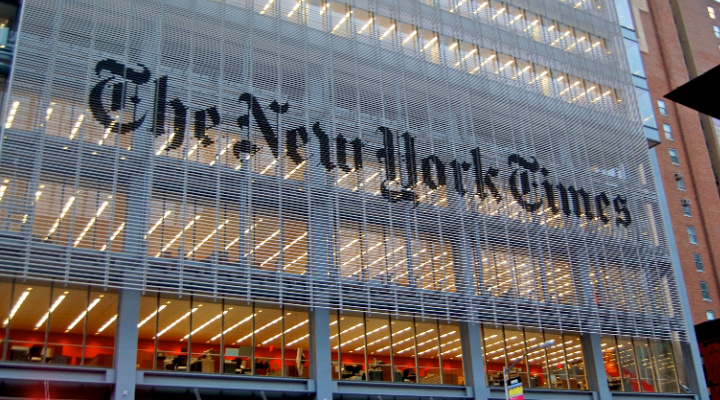
The New York Times building in New York City. Photo: Wikimedia Commons
A New York Times news account of the funeral of Hezbollah terrorist leader Hassan Nasrallah refers to his “charm” and “charisma.”
“He served many roles in the lives of Hezbollah members, acting as a religious leader, political strategist and commander in chief,” the New York Times reporters Christina Goldbaum and Euan Ward wrote in a dispatch that the Times labeled as coming from Beirut, Lebanon. “His charm — a rarity among leaders in the region — was also key to unifying Hezbollah’s followers. The group’s current leader, Mr. Qassem, does not share Mr. Nasrallah’s stature or charisma.”
The CEO of the Anti-Defamation League, Jonathan Greenblatt, noted, “Nasrallah deserves no reverence, only the cold judgment of history. His hands were covered in the blood of innocents, his legacy is little more than death and suffering.” Greenblatt described Nasrallah as a “murderous terrorist” and as “a fanatic who spread anti-Semitism, extremism, and violence across the Middle East and beyond. His enduring legacy is one of death – thousands of Jews, Israelis, Lebanese, Syrians, Yemenis, and others fell victim to his reign of terror.”
I emailed Goldbaum and asked her: “I noticed in your NYT story today on Nasrallah’s funeral you refer to his ‘charm.’ What did you mean by that exactly? How would you respond to families of victims of Hezbollah-sponsored terrorism who did not find it charming to have their loved ones killed by Hezbollah?”
I also inquired, “Given that you are in Lebanon with a lot of armed Hezbollah people about, are you able to write the truth about Hezbollah or do you have to write nice things, like that Nasrallah was charming, because you are afraid of being kidnapped or killed if you tell the truth?”
She did not respond.
My Webster’s Second defines charming as “pleasing in a high degree; delighting; fascinating; of attractive character and personality.” It offers as synonyms “delightful, amiable, lovely, pleasing.”
When Nasrallah was killed, President Biden issued a statement noting that “his many victims” included “thousands of Americans, Israelis, and Lebanese civilians.”
The New York Times article from the funeral that discussed Nasrallah’s supposed “charm” made no mention of those victims. Nor did it mention Nasrallah’s notoriously threatening comment, as translated by Prime Minister Netanyahu, that “If all the Jews gather in Israel, it will save us the trouble of chasing them down around the world.”
The Times did not mention the 12 Druze children killed by a Hezbollah rocket strike on a soccer field in Majdal Shams in 2024 while Nasrallah led the terrorist group.
The US State Department says Hezbollah “is responsible for multiple large-scale terrorist attacks, including the 1983 suicide truck bombings of U.S. Embassy Beiruit and the U.S. Marine barracks; the 1984 attack on the U.S. Embassy Beirut annex; and the 1985 hijacking of TWA flight 847, during which U.S. Navy diver Robert Stethem was murdered.” It says the group “was also implicated, along with Iran, in the 1992 attacks on the Israeli embassy in Argentina and the 1994 bombing of the Argentine‑Israelite Mutual Association in Buenos Aires.” Some “charm.”
The Times article misleadingly refers to “Hezbollah’s raison d’être: armed resistance against Israeli occupation.” That understates Hezbollah’s true objective, which is subjugating Lebanon to Iranian control as part of the Iranian campaign to extend fanatic revolutionary Islamist clerical rule worldwide and put America and Israel to death along the way. In fact, the Times sanitized its report of the Nasrallah funeral by omitting from the account the violent chants heard there of “Death to America, Death to Israel.” The Times deceives readers by claiming Hezbollah is all about “Israeli occupation,” when it’s actually about “death to America.”
In addition to the bylines of Goldbaum and Ward, the Times article extolling Nasrallah’s “charm” also says “Dayana Iwaza and Jacob Roubai contributed reporting.” Iwaza’s Linked In and Instagram profiles identify her as a part time or free-lance contributor also to Aljazeera, a network controlled by Qatar that Israel says has served as cover for Hamas and Palestinian Islamic Jihad terrorists.
The Times article already carries one correction: “A correction was made on Feb. 23, 2025: An earlier version of this article misidentified the newly appointed president of Lebanon. He is Joseph Aoun, not Michel Aoun, a former president of the country.”
If the Times took its journalistic credibility more seriously, maybe it would add a second correction, or an editor’s note, to the effect that it was a ridiculous mistake to describe Hassan Nasrallah as “charming.” It’s one thing to quote someone as saying that, it’s quite another for the newspaper to report it as fact, unattributed, in the newspaper’s own voice. Where were the Times editors?
And what were the reporters thinking? If in fact they were intimidated by the tens of thousands of Hezbollah supporters, maybe the best thing for the Times to have done on this one would have been to write the story from somewhere safe, or at least to disclose to readers that the story was affected by a threat of violence.
Ira Stoll was managing editor of The Forward and North American editor of The Jerusalem Post. His media critique, a regular Algemeiner feature, can be found here.