 Pod Save America Hosts Call on Democrats to Cut All Israel Military Aid, No Longer Accept AIPAC Funding
 Jews, Israelis Targeted in Austria Amid Surge in Antisemitic Incidents; Local Jewish Community Calls for Action
 ‘All of Our Strength’: Over 1,000 Pro-Israel Activists Gather in DC for Solidarity Conference
 ‘Devastated’: Wesley LePatner, Killed in Manhattan Mass Shooting, Was a Jewish Communal, Philanthropic Leader
 Sen. Angus King Vows to No Longer Vote for Israel Military Aid Until Gaza Conditions Improve
 Europe Won’t Pressure Israel to ‘Commit Suicide’ Amid Gaza Backlash, Palestinian State Push, Says Israeli FM
 Israel’s National Soccer Coach Attacked in Athens Before Soccer Fans Chant ‘F–K Israel, Free Palestine’ at Match
 New York Judge Sentences Neo-Nazi to 5 Years for Livestreaming Bomb Threats Against Jewish Hospitals
 US Pressures Lebanon to Issue Cabinet Decision to Disarm Hezbollah Before Talks Continue
 UK Plans to Recognize Palestinian State in September Unless Israel Meets Conditions, Starmer Says


A Fascinating Look Into the Rise of Campus Hatred and Antisemitism
Error: Contact form not found.
 by Andrew Fox

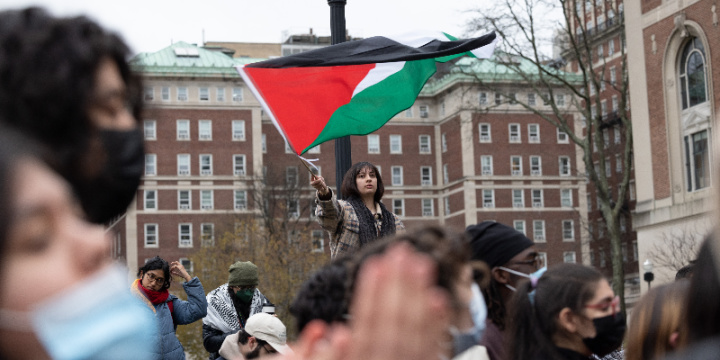
Pro-Hamas protesters at Columbia University on April 19, 2024. Photo: Melissa Bender via Reuters Connect
The latest offering from Jewish Quarterly provides a timely and thorough exploration of the state of antisemitism in contemporary universities. It particularly focuses on the rise of campus activism and its implications for academic freedom.
Mindless: What Happened to Universities? features an in-depth essay by Professor Cary Nelson, a respected scholar and former president of the American Association of University Professors. Nelson’s analysis is well-researched and candid, illuminating the ideological shifts within higher education and their consequences for open discourse.
Nelson’s essay is a critical reflection on how academic institutions have evolved in recent years, particularly in response to anti-Zionist activism, antisemitism, and the broader politicization of campus spaces. He examines how university environments, which should be spaces for debate and critical thinking, have increasingly become arenas for dogmatic activism, often at the expense of intellectual diversity. He argues that the Gaza Solidarity encampments that spread across Western campuses in 2024 were symptomatic of deeper issues in academia — specifically, the growing resistance to debate and the framing of complex geopolitical conflicts in binary terms.
Nelson does not claim that student activism itself is problematic. Rather, he critiques the extent to which some protests have crossed the line into intimidation and exclusion for Jewish students. The essay provides extensive and unsettling evidence of antisemitic rhetoric emerging in protests, alongside surveys indicating that over half of Jewish students in the US felt unsafe on campus in 2024. His argument is not that all activism is inherently harmful, but that in many cases, the principle of free inquiry has been overshadowed by ideological conformity and naked political activism in place of scholarship.
One of the strengths of Nelson’s essay is that it does not rely on alarmism; rather, he builds the case methodically. He traces the historical trajectory of academic institutions, illustrating how certain disciplines have gradually shifted toward ideological uniformity, especially in their framing of Israel and Zionism. He also emphasizes how some faculty members have actively promoted activism that extends beyond protest to include calls for exclusion and censorship.
Nelson’s essay is an important contribution for readers looking for a balanced critique. While he clearly finds much of the current campus climate troubling, he avoids sweeping generalizations. Instead, he focuses on specific examples of how anti-Zionist activism has, in some cases, led to exclusionary practices and threats to the psychological safety essential for learning. The result is an essay that invites reflection rather than simply reinforcing entrenched positions.
A particularly valuable aspect of this work is its examination of the role that faculty and administrators play in shaping campus climates. Nelson provides examples of professors who have actively celebrated extremist rhetoric, as well as administrators who have been hesitant to confront antisemitism under the guise of protecting free speech. He contrasts this with past university responses to other forms of discrimination, questioning why antisemitism is often treated differently, especially within the context of a polarizing broader debate over DEI and identity politics.
At the same time, the issue does not present a one-sided view of faculty involvement. There is an acknowledgment that many academics oppose the radicalization of campus discourse but feel unable to speak out due to professional risks. Whilst highlighting increasingly politicized humanities and social sciences departments, his nuanced approach strengthens the essay’s credibility, as it avoids portraying all faculty as complicit or all students as antagonistic.
The past year has witnessed intense debates over free speech, antisemitism, and academic freedom. Nelson’s essay provides an important perspective on how these discussions are unfolding in higher education. Although it does not purport to offer all the answers to antisemitism, it presents a well-argued assessment of the challenges facing universities and offers possible solutions.
Furthermore, the issue underscores how the internationalization of campus activism has influenced these trends. With protests erupting across North America, Europe, and Australia, Nelson places these developments within a global framework, showing that these issues are not limited to any one country or institution. Nelson’s writing is clear and persuasive, and helps frame the discussion within a broader historical and intellectual tradition.
Mindless is an important read for anyone concerned about the future of academic institutions and the principles of free inquiry. While some readers may disagree with Nelson’s conclusions, his work’s strength lies in its commitment to reasoned debate. It does not demand agreement but encourages deeper reflection, which is increasingly rare in today’s polarized discourse.
This issue is well worth reading for those who follow developments in higher education or are concerned about the growing tensions around academic freedom and antisemitism. Jewish Quarterly continues to demonstrate why it is a respected voice in Jewish intellectual and cultural discussions, and Mindless is a testament to its enduring relevance.
Andrew Fox served for 16 years in the British Army (2005-21). He was a senior lecturer at the Royal Military Academy Sandhurst, and is currently a research fellow at the Henry Jackson Society. Andrew provides regular commentary on defense and foreign policy across the media including articles in the New York Post, The Telegraph, The Spectator, and Spiked. He has amassed a large following across his digital platforms, including X (formerly Twitter) and Substack, where he writes on disinformation, defense and security.
Mindless is available at www.jewishquarterly.com