 Pod Save America Hosts Call on Democrats to Cut All Israel Military Aid, No Longer Accept AIPAC Funding
 Jews, Israelis Targeted in Austria Amid Surge in Antisemitic Incidents; Local Jewish Community Calls for Action
 ‘All of Our Strength’: Over 1,000 Pro-Israel Activists Gather in DC for Solidarity Conference
 ‘Devastated’: Wesley LePatner, Killed in Manhattan Mass Shooting, Was a Jewish Communal, Philanthropic Leader
 Sen. Angus King Vows to No Longer Vote for Israel Military Aid Until Gaza Conditions Improve
 Europe Won’t Pressure Israel to ‘Commit Suicide’ Amid Gaza Backlash, Palestinian State Push, Says Israeli FM
 Israel’s National Soccer Coach Attacked in Athens Before Soccer Fans Chant ‘F–K Israel, Free Palestine’ at Match
 New York Judge Sentences Neo-Nazi to 5 Years for Livestreaming Bomb Threats Against Jewish Hospitals
 US Pressures Lebanon to Issue Cabinet Decision to Disarm Hezbollah Before Talks Continue
 UK Plans to Recognize Palestinian State in September Unless Israel Meets Conditions, Starmer Says


Turkish Delegation Visits Syria After Deal Between Damascus and Kurdish Forces
Error: Contact form not found.
 by Ailin Vilches Arguello

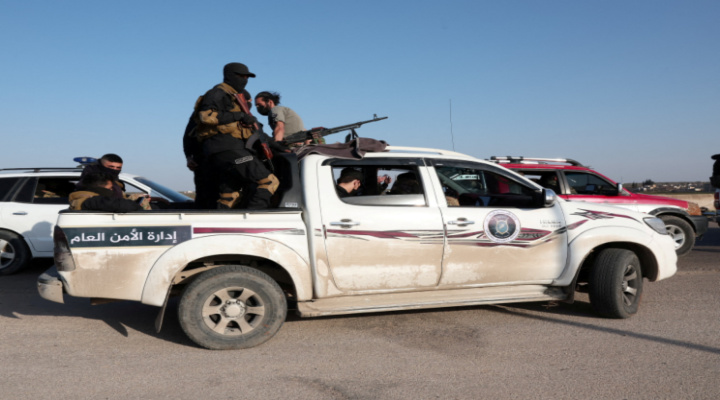
Syrian army personnel travel in a military vehicle as they head towards Latakia to join the fight against the fighters linked to Syria’s ousted leader Bashar al-Assad, in Aleppo, Syria, March 7, 2025. REUTERS/Mahmoud Hassano
A high-level Turkish delegation visited Syria after Damascus’ new government reached a deal with Kurdish forces, the Foreign Ministry said Thursday.
According to local media reports, Turkey’s Foreign Minister Hakan Fidan, Defense Minister Yaşar Güler, and the head of Turkey’s National Intelligence Organization, Ibrahim Kalın, are expected to meet with their Syrian counterparts as well as Damascus’ President Ahmed al-Sharaa.
During this meeting, they are expected to discuss the recent clashes between supporters of the ousted Assad regime and government forces, as well as the recent deal signed between Syria’s new Islamist-led government — backed by Turkey — and the Kurdistan Workers’ Party (PKK) militant group.
Under the new deal between the Kurdish-led, US-backed Syrian Democratic Forces (SDF) and the Syrian government, the SDF will be integrated into Damascus’ institutions. In exchange, the agreement gives the Syrian government control over SDF-held civilian and military sites in the northeast region of the country, including border crossings, an airport, and oil and gas fields.
Turkey has long considered the SDF, which controls much of northeastern Syria, a terrorist group due to its alleged links with the PKK, which has been waging an insurgency war against the Turkish state for the past 40 years.
Since the fall of the Assad regime last year, Ankara has emerged as a key foreign ally of the new Syrian government, pledging to assist in rebuilding the country and training its armed forces. It has also repeatedly demanded that the YPG militia – which leads the SDF – disarm, disband, and expel its foreign fighters from Syria.
While Turkey welcomed the recent deal between the SDF and Damascus, it also said that it would need to see its implementation to ensure the YPG does not join Syrian state institutions or security forces as a bloc.
On Wednesday, a Turkish Defense Ministry official said that attacks on Kurdish militants in Syria were still ongoing, highlighting Turkey’s determination to fight against terrorism.
“There’s no change in our expectations for an end to terrorist activities in Syria, for terrorists to lay down their weapons, and for foreign terrorists to be removed from Syria,” a Turkish Defense Ministry source told the Turkish newspaper Daily Sabah.
“We’ll see how the agreement is implemented in the field,” the source is quoted as saying. “We will closely follow its positive or negative consequences.”
The United States also welcomed the recent ceasefire deal between the SDF and Damascus, with US Secretary of State Marco Rubio saying that Washington supports a political transition in Syria that ensures a reliable and non-sectarian governance structure to prevent further conflict.
In late January, al-Sharaa became Damascus’s transitional president after leading a rebel campaign that ousted Assad, whose Iran-backed rule had strained ties with the Arab world during the nearly 14-year Syrian war.
According to an announcement by the military command that led the offensive against Assad, Sharaa was given the authority to form a temporary legislative council for the transitional period and to suspend the country’s constitution.
The collapse of Assad’s regime was the result of an offensive spearheaded by Sharaa’s Islamist Hayat Tahrir al-Sham (HTS) group, a former al-Qaeda affiliate.
This week, al-Sharaa signed Syria’s constitutional declaration that will be enforced throughout a five-year transitional period.
Since Assad’s fall, the new Syrian government has sought to strengthen ties with Arab and Western leaders. Damascus’s new diplomatic relationships reflect a distancing from its previous allies, Iran and Russia.
The new Syrian government appears focused on reassuring the West and working to get sanctions lifted, which date back to 1979 when the US labeled Syria a state sponsor of terrorism and were significantly increased following Assad’s violent response to the anti-government protests.
The Assad regime’s brutal crackdown on opposition protests in 2011 sparked the Syrian civil war, during which Syria was suspended from the Arab League for more than a decade.