 Pod Save America Hosts Call on Democrats to Cut All Israel Military Aid, No Longer Accept AIPAC Funding
 Jews, Israelis Targeted in Austria Amid Surge in Antisemitic Incidents; Local Jewish Community Calls for Action
 ‘All of Our Strength’: Over 1,000 Pro-Israel Activists Gather in DC for Solidarity Conference
 ‘Devastated’: Wesley LePatner, Killed in Manhattan Mass Shooting, Was a Jewish Communal, Philanthropic Leader
 Sen. Angus King Vows to No Longer Vote for Israel Military Aid Until Gaza Conditions Improve
 Europe Won’t Pressure Israel to ‘Commit Suicide’ Amid Gaza Backlash, Palestinian State Push, Says Israeli FM
 Israel’s National Soccer Coach Attacked in Athens Before Soccer Fans Chant ‘F–K Israel, Free Palestine’ at Match
 New York Judge Sentences Neo-Nazi to 5 Years for Livestreaming Bomb Threats Against Jewish Hospitals
 US Pressures Lebanon to Issue Cabinet Decision to Disarm Hezbollah Before Talks Continue
 UK Plans to Recognize Palestinian State in September Unless Israel Meets Conditions, Starmer Says


‘Starving’ Gazans Reappear in New York Times, Ahead of Schedule
Error: Contact form not found.
 by Ira Stoll

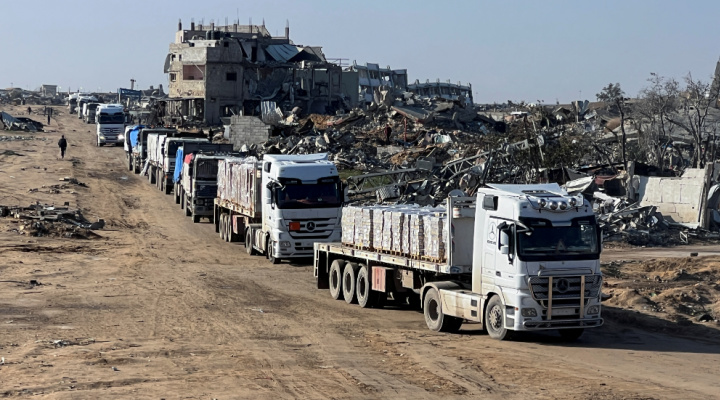
Trucks carrying aid move, amid a ceasefire between Israel and Hamas, in Rafah in the southern Gaza Strip, Feb. 13, 2025. Photo: REUTERS/Hussam Al-Masri
In the asymmetrical warfare that characterizes the Israel-Hamas war, Israel has the power to cut off the flow of goods and supplies into Gaza, and Hamas has the power to turn on the supply of sympathetic press coverage featuring supposedly starving Gazans.
Israeli Prime Minister Netanyahu announced on March 2 that, with Hamas refusing an American framework to release hostages, “as of this morning, the entry of goods and supplies into Gaza will be prevented.” Netanyahu said that Hamas “currently controls all of the supplies and goods that are being sent to the Gaza Strip … and is turning the humanitarian aid into a budget for terrorism directed against us.”
At that time, a spokesman for the Israeli foreign ministry, Oren Marmorstein, said, “Massive amounts of goods have already been delivered to the Gaza Strip, and there is no shortage of essential products in the Strip. The quantities of goods are so large that they are expected to last for at least several more months.”
Yet it took not “several more months,” but merely a couple weeks for the New York Times to supply its readers with the narrative that Israel — not Hamas — is responsible for starving the Gazans.
“Israeli officials are essentially starving Gaza as a negotiation tactic,” a Times contributing opinion writer, Megan Stack, wrote.
The same anti-Israel talking point turned up in the Times‘ news pages, as the news-opinion distinction is increasingly blurred at the publication, with the anti-Israel agenda visible on both the editorial page and the news sections.
The news side’s version of the Megan Stack starvation accusation came in an article that appeared in print with the headline “Desperation Grips Gaza as Israel Keeps Aid Out.” The online headline was, “Bread Lines and Salty Drinking Water: Israeli Aid Block Sets Gaza Back Again.” The online article included a Hollywood-quality video of Gazans energetically jostling for food handouts.
The Times news article included credit to Vivian Yee, Bilal Shbair, Saher Alghorra, Erika Solomon, Ameera Harouda, and Rania Khaled, another example of the principle that the more journalists are named as involved in a story, the less credible it is. Shbair was described as having reported from Deir al-Balah, Gaza, “where he interviewed vegetable sellers, police officers, and ordinary people searching for food.” Police officers is a polite Times way of saying “armed Hamasniks.” Alghorra was described as having reported “from northern and central Gaza.”
Elsewhere and earlier, in a moment of candor, the Times Jerusalem bureau chief, Patrick Kingsley, acknowledged to readers, “Hamas restricts journalists in Gaza.” The article about “desperation” gripping Gaza carried no disclosure to readers about those restrictions. What were the Times journalists restricted from asking about or including in their story, either explicitly or informally by self-censorship because of their own awareness of the cruel brutality with which Hamas dispatches its perceived internal enemies?
For example, it’s possible that without the Hamas-imposed restrictions on journalists, a Times article about Gaza bread lines could have at least explored the possibility that the setback of Gaza might not be attributable entirely to the “Israeli aid block,” but also to Hamas refusing to release the Israeli and foreign hostages in Gaza, to Egypt and Jordan refusing to accept the Gazans as refugees, and to Hamas stealing and hoarding the humanitarian aid.
The Times said the aid cutoff had been “exacerbated by panic buying and unscrupulous traders who gouge prices,” but it didn’t mention Hamas hoarding the aid. There was a brief Times reference to Israeli “assertions that Hamas is taking over the aid entering Gaza and that half the group’s budget in Gaza comes from exploiting aid trucks.” If the Times has two reporters in Gaza, this might be a useful topic for them to investigate, along with video.
The Times dispatch reported that “Hamas police officers have warned businesses against price-gouging, vendors and shoppers said.” It quoted one Hamas police officer, “Khalil Reziq, 38, a police officer in the city of Khan Younis in central Gaza whose division oversees markets and shops,” claiming, “his unit had confiscated vendors’ goods and sold them for cheaper on the spot.” The idea that Hamas is valiantly combating price inflation in Gaza instead of contributing to it by siphoning off the supplies to supply its terrorist fighters and to fuel its rockets aimed at Israel is laughable.
If Times reporters in Gaza are supplying this nonsense, at least they can offer, by way of explanation, that they fear being killed by Hamas if they write the whole truth. What’s less understandable is why Times editors, safe in New York, move this copy along. Perhaps the real “desperation” is from Times management trying to satiate the hunger from the news organization’s far-left and global readership for coverage depicting Israel as solely responsible for suffering.
Ira Stoll was managing editor of The Forward and North American editor of The Jerusalem Post. His media critique, a regular Algemeiner feature, can be found here.