 Pod Save America Hosts Call on Democrats to Cut All Israel Military Aid, No Longer Accept AIPAC Funding
 Jews, Israelis Targeted in Austria Amid Surge in Antisemitic Incidents; Local Jewish Community Calls for Action
 ‘All of Our Strength’: Over 1,000 Pro-Israel Activists Gather in DC for Solidarity Conference
 ‘Devastated’: Wesley LePatner, Killed in Manhattan Mass Shooting, Was a Jewish Communal, Philanthropic Leader
 Sen. Angus King Vows to No Longer Vote for Israel Military Aid Until Gaza Conditions Improve
 Europe Won’t Pressure Israel to ‘Commit Suicide’ Amid Gaza Backlash, Palestinian State Push, Says Israeli FM
 Israel’s National Soccer Coach Attacked in Athens Before Soccer Fans Chant ‘F–K Israel, Free Palestine’ at Match
 New York Judge Sentences Neo-Nazi to 5 Years for Livestreaming Bomb Threats Against Jewish Hospitals
 US Pressures Lebanon to Issue Cabinet Decision to Disarm Hezbollah Before Talks Continue
 UK Plans to Recognize Palestinian State in September Unless Israel Meets Conditions, Starmer Says


NY Times Platforms ‘Progressive’ Activist Who Called Oct. 7 ‘Provoked’ and Compared Hamas to Holocaust Survivors
Error: Contact form not found.
 by Rachel O'Donoghue


A taxi passes by in front of The New York Times head office, Feb. 7, 2013. Photo: Reuters / Carlo Allegri
The documentary No Other Land, a joint Israeli-Palestinian production that won an Academy Award earlier this month, is not “just a film” — at least according to a guest essay in The New York Times by Rania Batrice and Libby Lenkinski.
Batrice, described by the Times as a Palestinian-American activist and “strategist for progressive causes,” and Israeli-American activist Lenkinski, argue that No Other Land is much more than a movie — it’s a “statement, a challenge, and an act of defiance.”
Batrice and Lenkinski argue that the film’s Israeli and Palestinian creators are “defying the zero-sum logic that dominates the region” by working together.
Yet, as they acknowledge, No Other Land has faced criticism from both Israelis and Palestinians. Among the latter, the Boycott, Divestment, and Sanctions (BDS) campaign condemned Palestinian activist Basel Adra for collaborating with Israeli filmmaker Yuval Abraham.
According to Batrice and Lenkinski, this opposition has “undermined the joint artistic work that directly criticizes the Israeli government.”
Oscar-winning Israeli journalist Yuval Abraham and Palestinian activist Basel Adra claim to show “life under occupation” in Masafer Yatta, yet their doc distorts the area’s true history. When you start with a pre-written script, propaganda wins out over facts. pic.twitter.com/7z2vLjp2Ev
— HonestReporting (@HonestReporting) March 7, 2025
This, ultimately, is the core message of their essay: No Other Land presents a model of collaboration in which Israeli activists align with Palestinian efforts to challenge Israel’s legitimacy — what Batrice and Lenkinski euphemistically call “co-resistance.”
It’s a charming spin. After all, “resistance” is precisely the term that Hamas uses for every suicide bombing and stabbing attack it orchestrates against Israeli civilians.
Batrice and Lenkinski are now attempting to repackage the term, stripping it of its violent connotations. See? Israelis are “resisting” too. It’s non-violent. It’s peaceful. It’s art.
“If there is any hope for the future, it lies precisely in these partnerships, in collaboration, and in what the filmmakers aptly call ‘co-resistance,’” they write.
There’s just one problem. One of the essay’s authors had a rather different interpretation of “resistance” on October 7, when Hamas terrorists, aided by Gazan civilians, invaded Israel, massacred 1,200 people, and dragged 251 more back to Gaza as hostages.
On that day — the morning Israelis woke to hundreds of rockets and videos flooding social media of men, women, and children being hunted down, shot, stabbed, and bludgeoned — Rania Batrice was busy amplifying Hamas propaganda.
She shared footage of terrorists paragliding into Israel and opening fire, complete with a text overlay likening them to Jews smuggling weapons into Nazi ghettos during the Holocaust.
Rania Batrice posted a video of Hamas’ Oct. 7 attacks that described terrorists attacking civilians as “resistance… invading illegal settlements housing illegal settlers.”
Now this “progressive” Palestinian American activist is writing in @nytimes. 🧵 pic.twitter.com/7COOZ5XMV7
— HonestReporting (@HonestReporting) March 17, 2025
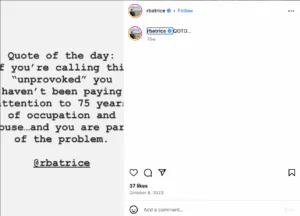
And 24 hours later — on October 8, 2023, when even the most committed apologists could no longer claim ignorance about the scale of the atrocities — Batrice doubled down, declaring that anyone who described the attack as “unprovoked” was “part of the problem.”
The Times essay calls No Other Land a “challenge” — and in a way, that’s true.
It’s certainly a challenge to take seriously a film that distorts decades of legal rulings and historical facts so thoroughly that its inclusion in the Academy’s documentary category was an insult in itself.
But the Times essay itself presents an even greater challenge: How does one reconcile its co-author’s supposed belief in the unity of Israelis and Palestinians when on the day of the bloodiest massacre in Israeli history, she was celebrating?
The author is a contributor to HonestReporting, a Jerusalem-based media watchdog with a focus on antisemitism and anti-Israel bias — where a version of this article first appeared.