 Pod Save America Hosts Call on Democrats to Cut All Israel Military Aid, No Longer Accept AIPAC Funding
 Jews, Israelis Targeted in Austria Amid Surge in Antisemitic Incidents; Local Jewish Community Calls for Action
 ‘All of Our Strength’: Over 1,000 Pro-Israel Activists Gather in DC for Solidarity Conference
 ‘Devastated’: Wesley LePatner, Killed in Manhattan Mass Shooting, Was a Jewish Communal, Philanthropic Leader
 Sen. Angus King Vows to No Longer Vote for Israel Military Aid Until Gaza Conditions Improve
 Europe Won’t Pressure Israel to ‘Commit Suicide’ Amid Gaza Backlash, Palestinian State Push, Says Israeli FM
 Israel’s National Soccer Coach Attacked in Athens Before Soccer Fans Chant ‘F–K Israel, Free Palestine’ at Match
 New York Judge Sentences Neo-Nazi to 5 Years for Livestreaming Bomb Threats Against Jewish Hospitals
 US Pressures Lebanon to Issue Cabinet Decision to Disarm Hezbollah Before Talks Continue
 UK Plans to Recognize Palestinian State in September Unless Israel Meets Conditions, Starmer Says


What the Gaza Protests Mean for Hamas — and Israel
Error: Contact form not found.
 by Dan Harris

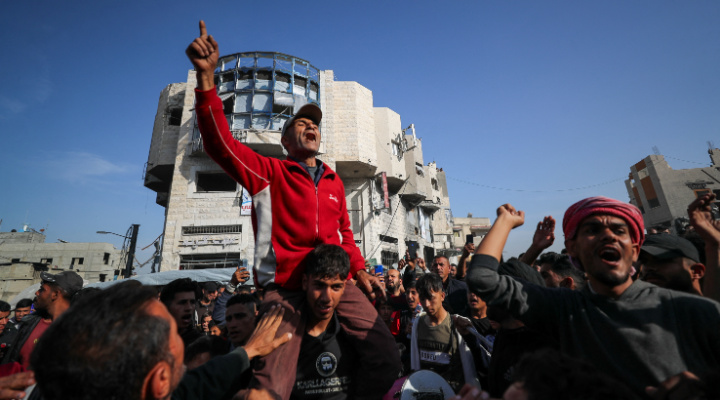
Palestinians protest to demand an end to war, chanting anti-Hamas slogans, in Beit Lahiya in the northern Gaza Strip, March 26, 2025. Photo: REUTERS/Stringer
Many commentators have withheld judgement as to the significance of the anti-Hamas protests in Beit Lahiya and other towns in northern Gaza. They argue that it is too early to tell.
The protests are undoubtedly significant for several reasons. Complaints against Hamas have now bubbled to the surface, no longer hidden behind closed doors. The preparation of hand-held signs indicates some degree of planning (and therefore, open chatter amongst the populace). The sheer scale, with protestors reportedly numbering in the thousands, is significant in and of itself. That they are prepared to weather the threat of a violent crack-down by Hamas is also telling. It speaks to the frustration, the anger, and the despair.
We need not dwell on these points; they are obvious. Instead, we must consider the subtleties that make these protests highly significant and relevant to strategic planners. They point less towards the protests as an isolated event and more towards the start of a possible process leading to the removal of Hamas.
One protestor has been reported as saying that, “the protest was not about politics. It was about people’s lives.” This distinguishes the protests from Israel’s reasons for removing Hamas, which are political. The distinction is crucial. It differentiates the protestors’ position from that of Israel. And that will energize them and provide them with the justification they need to continue the protests. This is because they can argue that they are not aligned with Israel.
We cannot ignore the fact that for the overwhelming majority of Palestinians in Gaza, the long-standing maxim that “my enemy’s enemy is my friend” is problematic if it means that Israel has become their friend. These are, after all, part of a population that cheered on October 7, and again a year later as they viewed Iranian missiles light up the skies above Israel.
The social nature of the protests is critical in another important respect. The anti-Hamas chants that demand an end to Hamas’ power are undoubtedly political. However, just as uprisings during the Arab Spring demanded the basics of bread, freedom, and social justice, so too here: an end to death and destruction is as basic and universal as it gets. Thus, the anti-war demand gives the protests a social soul. That gives the anti-Hamas political demand the potential to rise above divisive tensions which would inevitably arise if the protest was seen as political. That gives the protest movement more reach within Gaza.
The protests are also telling in another important respect — they fail, and in the future will likely fail, to offer an alternative to Hamas rule of the enclave. What this tells us is that there is no longer a universally held idea of an inviolable Palestinian state amongst those on the ground. No vision of the future; just as long as it does not include Hamas.
How might this play out? No one can say, but these points indicate that this may be the start of a process. Crucially, there is asymmetry. The protestors may not be able to securitize their protests with weapons, but they have one crucial weapon: information. They either know, or know someone who knows, where each hostage is. That gives them the power to rapidly and decisively de-lever Hamas’ negotiating position. And Hamas no longer knows whether the code of silence still holds.
Dan Harris is an international lawyer. He studied politics at Cambridge and now advises many of the world’s most systemically important hedge funds trading geopolitical events. He is also a specialist in boycotts, sanctions and divestment in the financial markets. He has been quoted by many major news outlets, including the Financial Times and the Jerusalem Post and is the author of the Trojan Bourse, analyzing BDS in the financial markets.