 Pod Save America Hosts Call on Democrats to Cut All Israel Military Aid, No Longer Accept AIPAC Funding
 Jews, Israelis Targeted in Austria Amid Surge in Antisemitic Incidents; Local Jewish Community Calls for Action
 ‘All of Our Strength’: Over 1,000 Pro-Israel Activists Gather in DC for Solidarity Conference
 ‘Devastated’: Wesley LePatner, Killed in Manhattan Mass Shooting, Was a Jewish Communal, Philanthropic Leader
 Sen. Angus King Vows to No Longer Vote for Israel Military Aid Until Gaza Conditions Improve
 Europe Won’t Pressure Israel to ‘Commit Suicide’ Amid Gaza Backlash, Palestinian State Push, Says Israeli FM
 Israel’s National Soccer Coach Attacked in Athens Before Soccer Fans Chant ‘F–K Israel, Free Palestine’ at Match
 New York Judge Sentences Neo-Nazi to 5 Years for Livestreaming Bomb Threats Against Jewish Hospitals
 US Pressures Lebanon to Issue Cabinet Decision to Disarm Hezbollah Before Talks Continue
 UK Plans to Recognize Palestinian State in September Unless Israel Meets Conditions, Starmer Says


Northwestern University Touts Progress on Addressing Campus Antisemitism Amid Federal Scrutiny
 by Dion J. Pierre

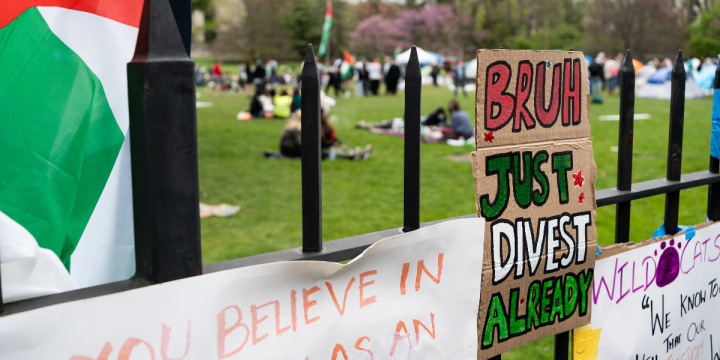
Signs cover the fence at a pro-Palestinian encampment at Northwestern University in Evanston, Ill. on April 28, 2024. Photo: Max Herman via Reuters Connect.
Northwestern University on Monday touted its progress in addressing the campus antisemitism crisis, issuing a statement containing a checklist of policies it has enacted since being censured by federal lawmakers over its handling of pro-Hamas demonstrations which convulsed its campus during the 2023-2024 academic year.
“The university administration took this criticism to heart and spent much of last summer revising our rules and policies to make our university safe for all of our students, regardless of their religion, race, national origin, sexual orientation, or political viewpoint,” the statement said. “Among the updated policies is our Demonstration Policy, which includes new requirements and guidance on how, when, and where members of the community may protest or otherwise engage in expressive activity.”
The university added that it has adopted the International Holocaust Remembrance Alliance (IHRA) definition of antisemitism, a reference tool which aids officials in determining what constitutes antisemitism, and begun holding “mandatory antisemitism training” sessions which “all students, faculty, and staff” must attend.
“This included a live training for all new students in September and a 17-minute training module for all enrolled students, produced in collaboration with the Jewish United Fund,” it continued. “Antisemitism trainings will continue as a permanent part of our broader training in civil rights and Title IX.”
Other initiatives rolled out by the university include an Advisory Council to the President on Jewish Life, dinners for Jewish students hosted by administrative officials, and educational events which raise awareness of rising antisemitism in the US and across the world. Additionally, Northwestern said that it imposed disciplinary sanctions against several students and one staff member whose conduct violated the new “Demonstration and/or Display Policies” which regulate peaceful assembly on the campus.
“In closing, although Northwestern has made significant progress in the fight against antisemitism on campus, the university remains vigilant and will continue to do what is necessary to make our campus safe,” the statement concluded. “Importantly, the fight against antisemitism is NOT [sic] a zero-sum game. All members of our communities on campus — all religions, races, national origins, genders, sexual orientations, and political viewpoints — deserve to feel safe and know that our rules will be enforced to protect them against hate, discrimination, harassment, and intimidation. Northwestern is committed to this principle.”
As previously reported by The Algemeiner, Northwestern University struggled for months to correct an impression that it coddled pro-Hamas protesters and acceded to their demands for a boycott of Israel in exchange for an end to their May 2024 encampment.
University president Schill denied during a US congressional hearing held that year that he had capitulated to any demand that fostered a hostile environment, but his critics noted that part of the deal to end the encampment stipulated his establishing a scholarship for Palestinian undergraduates, contacting potential employers of students who caused recent campus disruptions to insist on their being hired, creating a segregated dormitory hall that will be occupied exclusively by students of Middle Eastern and North African (MENA) and Muslim descent, and forming a new advisory committee in which anti-Zionists students and faculty may wield an outsized voice.
The status of those concessions, which a law firm representing the civil rights advocacy group StandWithUs described as “outrageous” in July 2024, was not disclosed in Monday’s statement.
Northwestern University is not the only school creating distance between itself and the anti-Zionist movement, a step many colleges have taken in response to US President Donald Trump’s vowing to cut the flow of taxpayer funds supplementing their budgets should they refuse to crackdown down on illegal protests and antisemitism. Following the Trump administration’s cancelling of over $400 million in federals contracts and grants awarded to Columbia University, former interim president Katrina Armstrong proposed a list of reforms the school would agree to undertake — in areas ranging from undergraduate admissions to campus security — to restore the funds.
Armstrong later resigned from her position, saying in a statement which explained the decision that she wishes to return to her role as executive director of the university’s Irving Medical Center, as well as several other positions she holds.
Meanwhile, Harvard University recently fired a librarian whom someone filmed ripping posters of the Bibas children, two babies murdered in captivity by Hamas, off a kiosk in Harvard Yard and denounced him as “hateful.” Additionally, it paused a partnership with a higher education institution located in the West Bank, a move for which prominent members of the Harvard community and federal lawmakers had clamored in a series of public statements. The Trump administration initiated a review of $9 billion in taxpayer funds it receives anyway, prompting interim president Alan Garber to defend Harvard’s handling of the issue.
“For the past fifteen months, we have devoted considerable effort to addressing antisemitism,” Garber said. “We have strengthened our rules and our approach to disciplining those who violate them. We have enhanced training and education on antisemitism across our campus and introduced measures to support our Jewish community and ensure student safety and security.”
Northwestern University is in the Trump administration’s crosshairs too. It is one of 60 universities being investigated by the Department of Education’s Office for Civil Rights over its handling of campus antisemitism, a project that will serve as an early test of the administration’s ability to perform the essential functions of the agency after downsizing its workforce to increase its efficiency.
“The department is deeply disappointed that Jewish students studying on elite US campuses continue to fear for their safety amid the relentless antisemitic eruptions that have severely disrupted campus life for more than a year,” Education Secretary Linda McMahon said in March. “US colleges and universities benefit from enormous public investments funded by US taxpayers. That support is a privilege, and it is contingent on scrupulous adherence to federal antidiscrimination laws.”
Follow Dion J. Pierre @DionJPierre.