 Pod Save America Hosts Call on Democrats to Cut All Israel Military Aid, No Longer Accept AIPAC Funding
 Jews, Israelis Targeted in Austria Amid Surge in Antisemitic Incidents; Local Jewish Community Calls for Action
 ‘All of Our Strength’: Over 1,000 Pro-Israel Activists Gather in DC for Solidarity Conference
 ‘Devastated’: Wesley LePatner, Killed in Manhattan Mass Shooting, Was a Jewish Communal, Philanthropic Leader
 Sen. Angus King Vows to No Longer Vote for Israel Military Aid Until Gaza Conditions Improve
 Europe Won’t Pressure Israel to ‘Commit Suicide’ Amid Gaza Backlash, Palestinian State Push, Says Israeli FM
 Israel’s National Soccer Coach Attacked in Athens Before Soccer Fans Chant ‘F–K Israel, Free Palestine’ at Match
 New York Judge Sentences Neo-Nazi to 5 Years for Livestreaming Bomb Threats Against Jewish Hospitals
 US Pressures Lebanon to Issue Cabinet Decision to Disarm Hezbollah Before Talks Continue
 UK Plans to Recognize Palestinian State in September Unless Israel Meets Conditions, Starmer Says


Netanyahu to Visit Azerbaijan in Effort to Deepen Strategic Ties Amid Regional Tensions
Error: Contact form not found.
 by Ailin Vilches Arguello

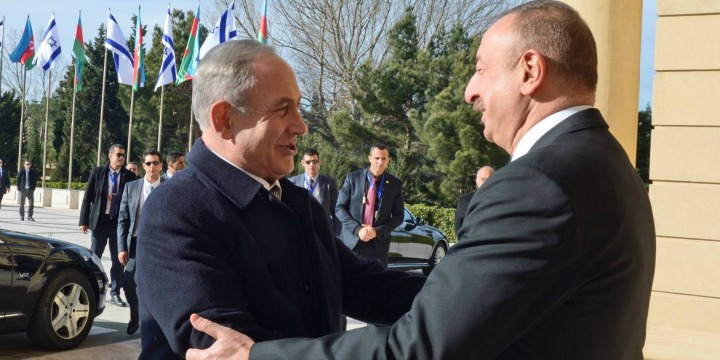
Israeli Prime Minister Benjamin Netanyahu with Azerbaijani President Ilham Aliyev. Photo: Facebook.
Israeli Prime Minister Benjamin Netanyahu will travel to Azerbaijan next Wednesday for a five-day visit to meet with President Ilham Aliyev and further strengthen bilateral cooperation amid regional tensions.
Netanyahu’s trip, facilitated by Baku’s mediation that led Turkey to approve his transit through Turkish airspace, comes just days after Iranian President Masoud Pezeshkian visited Azerbaijan amid ongoing nuclear negotiations with the United States.
Last year, Turkey barred Israeli President Isaac Herzog’s aircraft from flying over its territory, which prevented him from attending the 2024 United Nations Climate Change Conference in Baku.
During the upcoming visit, Netanyahu and Aliyev are expected to address Turkey’s role in Syria and the recent Israeli-Turkish discussions held in Baku, focused on avoiding potential clashes or misunderstandings over military operations in the region.
Scheduled from May 7 to May 11, Netanyahu’s visit will also include a series of high-level meetings focused on strengthening Israeli-Azerbaijani relations, covering areas such as defense cooperation, energy, trade, and regional security. The Israeli leader will also meet with representatives of Azerbaijan’s Jewish community.
Azerbaijan’s ties with Israel have long been significant, with the country serving as the Jewish state’s most vital ally in the Caucasus and Central Asia for more than three decades, fostering a partnership that spans energy security, defense, and intelligence.
As a predominantly Shi’ite Muslim country that shares a lengthy border with Iran while maintaining strong ties with both Israel and Turkey, Azerbaijan holds a unique strategic advantage in stabilizing regional tensions and supporting efforts to normalize relations.
Earlier this month, for example, Azerbaijan positioned itself as a regional mediator by hosting talks between Turkish and Israeli officials in Baku, aimed at preventing unintended incidents in Syria, where both countries maintain a military presence.
“Azerbaijan plays a unique role in Israel’s broader strategy by serving as a potential bridge for normalizing relations between the Jewish State and other Muslim-majority countries,” Rabbi Marc Schneier, president of the Foundation for Ethnic Understanding, told The Algemeiner in an exclusive interview.
He explained that Baku has contributed to regional normalization efforts in the past, notably by facilitating the restoration of full diplomatic ties between Turkey and Israel in 2022, even though the relationship between the two countries has since gone downhill.
According to Schneier, as a strong ally of both Jerusalem and Ankara, Azerbaijan is well-positioned to mediate further diplomatic breakthroughs.
Baku’s strategic importance stems not only from its role at the crossroads of a growing pro-Western bloc countering the regional ambitions of Iran, but also from its economic influence in the region.
Azerbaijan and Israel have continued to expand their cooperation and strengthen their bilateral ties, especially in the energy sector, highlighting the predominantly Shi’ite Muslim country’s emerging role as a strategic player in the Middle East.
Earlier this year, Jerusalem and Azerbaijan’s state oil company, SOCAR, struck a major energy deal. In March, SOCAR also signed a gas exploration license agreement with the Jewish state.
As of 2019, Azerbaijan supplied over a third of Israel’s oil. Last year, Jerusalem was the sixth-biggest buyer of oil from Baku, with sales totaling $713 million.
Meanwhile, Azerbaijan has acquired advanced Israeli defense systems, including the “Barak MX” missile system and surveillance satellites, and remains a leading buyer of Israeli military hardware, which was crucial in its 2020 war with Armenia.