 Pod Save America Hosts Call on Democrats to Cut All Israel Military Aid, No Longer Accept AIPAC Funding
 Jews, Israelis Targeted in Austria Amid Surge in Antisemitic Incidents; Local Jewish Community Calls for Action
 ‘All of Our Strength’: Over 1,000 Pro-Israel Activists Gather in DC for Solidarity Conference
 ‘Devastated’: Wesley LePatner, Killed in Manhattan Mass Shooting, Was a Jewish Communal, Philanthropic Leader
 Sen. Angus King Vows to No Longer Vote for Israel Military Aid Until Gaza Conditions Improve
 Europe Won’t Pressure Israel to ‘Commit Suicide’ Amid Gaza Backlash, Palestinian State Push, Says Israeli FM
 Israel’s National Soccer Coach Attacked in Athens Before Soccer Fans Chant ‘F–K Israel, Free Palestine’ at Match
 New York Judge Sentences Neo-Nazi to 5 Years for Livestreaming Bomb Threats Against Jewish Hospitals
 US Pressures Lebanon to Issue Cabinet Decision to Disarm Hezbollah Before Talks Continue
 UK Plans to Recognize Palestinian State in September Unless Israel Meets Conditions, Starmer Says


Universities Aren’t Cracking Down on ‘Anti-Israel’ Views; They Are Cracking Down on Supporting Terrorism and Harassing Students
Error: Contact form not found.
 by Daniel Beaudoin

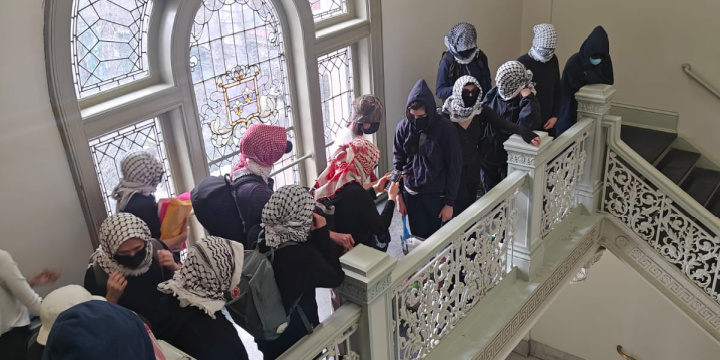
Columbia University Apartheid Divest (CUAD) members occupying an administrative building at Barnard College on Feb. 26, 2025. Photo: Screenshot
At universities like Columbia and Harvard, students are facing suspensions, arrests, and academic consequences following recent protests related to the war in Gaza. Some argue that this is an attack on free speech and student activism.
But the reality is different. Students are not being punished for supporting Palestinian rights. They are facing consequences because too many of these protests have crossed a critical line: openly supporting Hamas, a terrorist organization responsible for the October 7 massacre in Israel.
In America, free speech protects the right to criticize governments, advocate for Palestinian self-determination, and demand a ceasefire. These are legitimate and important political positions. They deserve protection.
However, there is a sharp distinction between peaceful advocacy and the glorification of violence. Many recent campus protests have included slogans like “Glory to the martyrs,” calls for “resistance by any means,” and imagery celebrating Hamas. That is not free speech in the traditional sense. It becomes a form of incitement — especially when Jewish students are threatened, harassed, or made to feel unsafe.
This is not a minor semantic issue. Words, symbols, and slogans matter. When demonstrators glorify violence, they create an environment that feels unsafe, particularly for students who belong to communities that have been targets of that violence. Universities have a responsibility to intervene when speech escalates into intimidation and fear.
There’s a reason why so many Jewish students report fearing for their safety. At Columbia, some were advised by university officials to evacuate dorms. Across several campuses, Jewish students have been harassed with slurs, physically blocked from buildings, and made to feel that they are personally responsible for an international conflict simply because of their identity.
Protesting is a right. Intimidating classmates and celebrating terror is not.
When universities respond to these actions — through arrests, suspensions, or disciplinary processes — they are not punishing a political viewpoint. They are enforcing long-standing rules about safety, campus operations, and harassment. Occupying academic buildings without permission, refusing lawful orders, and promoting violence violate university policies — no matter the cause.
This is about action, not opinion. Students are not facing discipline for holding unpopular views. They are facing discipline because of the way they have chosen to express those views: by violating campus rules, disrupting learning environments, and in some cases, advocating for violence against others.
No one is asking for the suppression of Palestinian voices. Students absolutely have the right to criticize Israeli policies, call for humanitarian aid, and advocate for a two-state solution. What they don’t have the right to do is glorify terrorist groups that target civilians.
It’s important to remember that Hamas is responsible for the deadliest attack on Jews since the Holocaust. Elevating Hamas as a symbol of “resistance” erases the reality of the atrocities committed — including the mass murder of civilians, sexual violence, and hostage-taking. It sends a chilling message to Jewish students: your suffering doesn’t matter.
Moreover, supporting Hamas is not a matter of personal interpretation. Hamas is designated as a terrorist organization by the United States government. Universities have a legal and moral obligation not to allow campus spaces to become platforms for the support of such groups.
Universities are obligated to protect all students, including Jewish students, from violence and intimidation. The moment political advocacy slips into supporting terrorism and hatred, consequences are not only appropriate — they are necessary.
If universities allow their campuses to become safe havens for the glorification of terror, they betray their core missions: to foster open inquiry, to safeguard every student, and to promote respectful dialogue — not to enable extremism. Support for Palestinian rights must not become a cover for glorifying terrorism. If we are serious about free speech, justice, and equality, then we must also be serious about drawing a clear moral line against violence.
Defending campuses as places of safety, dialogue, and learning for all students is not censorship. It’s a defense of the very democratic values these institutions are meant to uphold.
Dr. Daniel Beaudoin is a senior lecturer in political science and crisis management at Tel Aviv University, and the executive director of the European International Society for Military Ethics.