 Pod Save America Hosts Call on Democrats to Cut All Israel Military Aid, No Longer Accept AIPAC Funding
 Jews, Israelis Targeted in Austria Amid Surge in Antisemitic Incidents; Local Jewish Community Calls for Action
 ‘All of Our Strength’: Over 1,000 Pro-Israel Activists Gather in DC for Solidarity Conference
 ‘Devastated’: Wesley LePatner, Killed in Manhattan Mass Shooting, Was a Jewish Communal, Philanthropic Leader
 Sen. Angus King Vows to No Longer Vote for Israel Military Aid Until Gaza Conditions Improve
 Europe Won’t Pressure Israel to ‘Commit Suicide’ Amid Gaza Backlash, Palestinian State Push, Says Israeli FM
 Israel’s National Soccer Coach Attacked in Athens Before Soccer Fans Chant ‘F–K Israel, Free Palestine’ at Match
 New York Judge Sentences Neo-Nazi to 5 Years for Livestreaming Bomb Threats Against Jewish Hospitals
 US Pressures Lebanon to Issue Cabinet Decision to Disarm Hezbollah Before Talks Continue
 UK Plans to Recognize Palestinian State in September Unless Israel Meets Conditions, Starmer Says


Why Do Saudi Arabia, Qatar, and the UAE Need All Those American Weapons?
Error: Contact form not found.
 by Lev Stesin

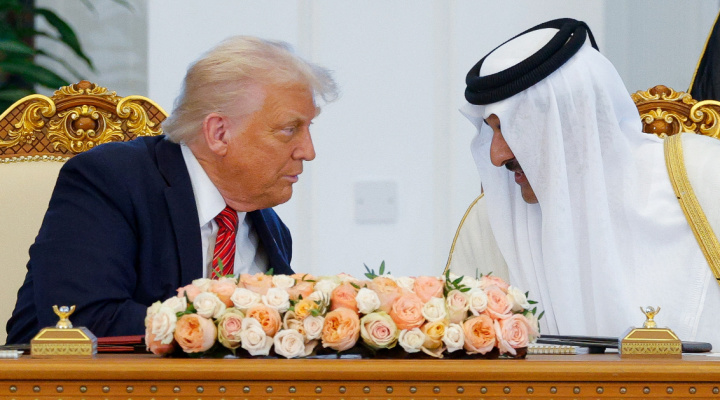
US President Donald Trump and Qatar’s Emir Tamim bin Hamad Al Thani attend a signing ceremony in Doha, Qatar, May 14, 2025. Photo: REUTERS/Brian Snyder
During last week’s visit to the Middle East, President Trump signed a number of arms deals with some of the richest countries in the region — Saudi Arabia, Qatar, and the United Arab Emirates. Some of these deals were unprecedented, both in terms of the quantity and quality of the weapons being sold.
From the business perspective, the deals were huge and perhaps beautiful, as the president might put it. The new and reemerging military conflicts of the last few years have set afoot a new arms race. The deals that were signed last week must be considered on two accounts: profit and strategic value.
On those terms, were these good deals?
The first logical question to ask is why Saudi Arabia, Qatar, and the United Arab Emirates need the most modern and sophisticated weapons? What kind of threats are these countries facing that would require such weapons to defend themselves?
All three face threats from radical Islam, though Saudi Arabia used to be — and Qatar currently is — sponsors of such Islamist movements around the world. Iran is claimed to be the current major conventional threat to all three. Yet Qatar is Iran’s ally. Moreover, Qatar has the largest American military base in the Middle East. If that is not the best insurance policy in the region, then none is.
In general, the entire security architecture of the Gulf States has rested and still rests on the US being the guarantor of their security. If one listens to the leaders in the Gulf and the words emanating from the White House, the US still is that guarantor and protector. It is true that the US has recently given signs that this commitment can’t be fully trusted, and the Gulf States want to have their own capability to defend themselves in case their ally becomes unreliable. Do these recent purchases provide enough material support to achieve their security independence? Can they use the equipment effectively to make a difference at a time of crisis?
The quality and quantity of weaponry does not guarantee victory. That observation has always been true, and is even more true today. From the fields of Ukraine to the mountains of Kashmir, the evidence suggests that a capable, smart, and willing to fight populace is as important. Saudi Arabia, Qatar, and the Emirates don’t have that.
Ironically, Qatar does not have much of a population at all, just a few hundred thousand masters supervising millions of people working and living in horrific conditions. Saudi Arabia is the largest country of the three, and has a population large enough to sustain a military force that can defend the country. However, its track record in that regard is beyond dismal — with their dismal performance in Yemen being the latest example (and American weapons didn’t get the job done there).
All three countries are politically unstable, with Saudi Arabia being the most volatile. Crown Prince Mohammed bin Salman is trying to achieve what no country or civilization has ever been able to do: leap over centuries of normal societal development, and come right into the modern world. This cultural upheaval in a country where only seven years ago women could not drive, is a very delicate balancing act. The Prince has so far succeeded in handling it — but these processes often end in revolutions. And if that happens, the new government will have serious US weapons. The US must be very careful selling the most sophisticated weapons to a country with a regime that does not have much legitimacy among its own population.
Putting aside the regimes’ stability, who will operate the numerous weapons platforms brought from the US? The war in Yemen clearly showed the countries don’t have the needed cadre of professionals at their disposal. It is not unreasonable to imagine Saudi Arabia, Qatar, and the Emirates solving this conundrum exactly the same way they solve all their problems: with money. Why not hire foreigners to operate the complex machinery? Or bring in American military advisors. There are already many military professionals, or even small armies, for hire. The Wagner Group is the most notorious of them all. But the US and some Europeans have other options. For the US and the rest of the world, the prospect of our most lethal weaponry operated by mercenaries is a horrifying idea indeed. The deals signed in the Gulf are very profitable deals, but they are also full of danger.
The author lives and works in Silicon Valley, California. He is a founding member of San Francisco Voice for Israel.