 Pod Save America Hosts Call on Democrats to Cut All Israel Military Aid, No Longer Accept AIPAC Funding
 Jews, Israelis Targeted in Austria Amid Surge in Antisemitic Incidents; Local Jewish Community Calls for Action
 ‘All of Our Strength’: Over 1,000 Pro-Israel Activists Gather in DC for Solidarity Conference
 ‘Devastated’: Wesley LePatner, Killed in Manhattan Mass Shooting, Was a Jewish Communal, Philanthropic Leader
 Sen. Angus King Vows to No Longer Vote for Israel Military Aid Until Gaza Conditions Improve
 Europe Won’t Pressure Israel to ‘Commit Suicide’ Amid Gaza Backlash, Palestinian State Push, Says Israeli FM
 Israel’s National Soccer Coach Attacked in Athens Before Soccer Fans Chant ‘F–K Israel, Free Palestine’ at Match
 New York Judge Sentences Neo-Nazi to 5 Years for Livestreaming Bomb Threats Against Jewish Hospitals
 US Pressures Lebanon to Issue Cabinet Decision to Disarm Hezbollah Before Talks Continue
 UK Plans to Recognize Palestinian State in September Unless Israel Meets Conditions, Starmer Says


Israel and Its Jihadist Adversaries Have Different Concepts of Time; Here’s Why That Matters
Error: Contact form not found.
 by Louis René Beres

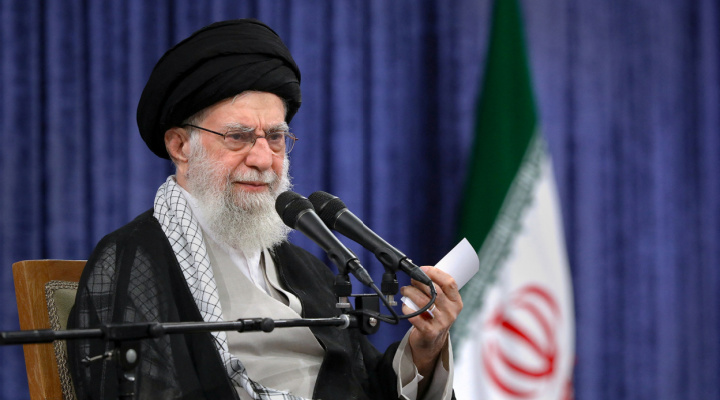
Iran’s Supreme Leader Ayatollah Ali Khamenei speaks during a meeting in Tehran, Iran, May 20, 2025. Photo: Office of the Iranian Supreme Leader/WANA (West Asia News Agency)/Handout via REUTERS
Whether the objective is war-winning, war-avoidance, or counter-terrorism, Israel should always assess its survival options “in time.”
In essence, the Jewish State’s policy makers need to consciously distinguish their own preferred ideas of time from the ideas of its foes. Though Israel lives according to “clock time,” its jihadi adversaries (state and sub-state terror-groups) regard such ordinary chronology as “profane time.”
The differences could mean life or death for Israel.
For Israel’s jihadi enemies, “real time” is discoverable only within palpably ecstatic moments of “martyrdom.”
At first, all this will sound excruciatingly theoretic. Nonetheless, it remains crucial to Israel’s survival. Jihadi notions of “sacred time” actively encourage “martyrdom operations.” Until now, and for the foreseeable future, this suggests steadily escalating violence against Israel.
At some worst-case point, a state enemy of Israel (most plausibly Iran) could effectively become a jihadi terrorist writ large. If macrocosm followed microcosm, a suicide bomber would become a “suicide state.” For the Jewish State, no such force magnification should ever be considered bearable, especially where the state aggressor was already nuclear.
Never to be overlooked in these complex matters is that Israel is less than half the size of America’s Lake Michigan. Accordingly, Iran frequently describes Israel as a “one-bomb state” — and it believes that Israel is subject to easy and instantaneous “removal.”
Though generally unrecognized, Israel’s jihadi adversaries (a category that now includes reconfiguring terror groups in post-Assad Syria, Lebanon, Yemen, Iraq, Qatar and other places) define ultimate victory as “power over death.” For these recalcitrant foes, becoming a “martyr” or shahid necessarily represents “power over time.”
For Israel, such challenging matters contain dense and perplexing ironies. Though Jerusalem’s defense and security policies ought always to be science-based, these policies would still benefit from being seen through the ideological lens of its adversaries.
History will deserve some pride of place. Significantly, the notion of time as “subjective duration” or “felt time” has its origins in ancient Israel. By rejecting time as simple linear progression, the early Hebrews generally approached chronology as a qualitative experience.
In terms of prospective nuclear threats from Iran or other places, Israeli planners should consider chronology not only at obvious operational levels, but also at levels of individual enemy decision-makers. What do authoritative leaders in Tehran think about time in shaping their military nuclear plans? For Israel’s prime minister and capable scholars, there could be no more urgent question.
From its beginnings, the Jewish prophetic vision was an imperiled community living “in time.” With this formative vision, political geography or “space” was vitally important. For present-day Israel, the space-time relationship reveals several less-philosophical security lessons. Any considered territorial surrenders by Israel (Judea/Samaria or “West Bank”) would reduce the amount of “objective time” that Israel has to resist war and terrorism. Serious questions are now being raised about the wisdom of Prime Minister Ariel Sharon’s “disengagement” from Gaza back in 2005.
Certain past Israeli surrenders, if considered “synergistically,” provided “extra time” for Israel’s enemies to wait patiently for optimal attack opportunities. In the future, similar territorial concessions could produce more genuinely intolerable costs. These potentially existential costs would concern jihadi terrorism and/or Iranian nuclearization.
If it could be determined that Iran and/or jihadi terror groups accept a shortening time horizon in their search for a “final victory” over Israel, Jerusalem’s response to enemy aggressions would have to be swift. If it would seem that a presumed enemy time horizon was calculably lengthening, Israel’s expected response could become more or less incremental.
For national security decision-makers, this would mean greater reliance on the passive dynamics of military deterrence and military defense than on active strategies of nuclear war fighting.
In the final analysis, a worst case for Israel would be to confront an already-nuclear and seemingly irrational Iran. Such an adversary could reasonably be described as a “suicide bomber in macrocosm.”
What else should Israel know about time? “Martyrdom” is widely accepted by hard-core Islamists as the most honorable and heroic way to soar above mortal limits imposed by “profane time.” Looked at from a more dispassionate analytic perspective, this practice is accepted by jihadists and Iran as a gratifying way to sanitize barbarism and justify mass murder of “unbelievers.” Sometimes, as we should note after October 7, 2023, this is also a lascivious way to overcome “profane time.”
Israel faces one overarching question: How can such perplexing correlations of death and time be suitably countered?
Israeli policy-makers will need to recognize these dense problems of chronology as policy-relevant quandaries. They will also need to acknowledge that any still-plausible hopes for national security must be informed by reason. Jewish theory of law is unique in its synthesis of logic and belief. It offers a transcending order revealed by the “divine word” as interpreted by human reason.
In the commands of Ecclesiastes 32.23, 37.16, 13-14: “Let reason go before every enterprise and counsel before any action … And let the counsel of thine own heart stand … For a man’s mind is sometimes wont to tell him more than seven watchmen that sit above in a high tower …”
An immediate goal for Israel’s reason-backed policy planners should be a fuller understanding of the nation’s enemies concept of time. Though generally overlooked even by Jerusalem’s dedicated strategic thinkers, such an understanding would be indispensable to counter-terrorism and nuclear war avoidance. For the continuously-beleaguered Jewish State, all time will remain “unredeemable.”
Prof. Louis René Beres was educated at Princeton (Ph.D., 1971) and is the author of many books and scholarly articles dealing with international law, nuclear strategy, nuclear war, and terrorism. In Israel, Prof. Beres was Chair of Project Daniel (PM Sharon). His 12th and latest book is Surviving Amid Chaos: Israel’s Nuclear Strategy (Rowman & Littlefield, 2016; 2nd ed., 2018).